We are pleased to bring you this year’s ASCL Annual Report. This is where we set out how we have been supporting and representing members, and how we’ve ensured that we’re providing value for money.
It has been another busy and eventful year with a change of Prime Minister and Education Secretary. There have been a huge number of policy announcements, which will result in major changes in the education sector over the next few years.
In fact, one of our biggest concerns is the risk of sheer overload of a workforce that is already under intense pressure. A major focus for ASCL over the autumn will be around the need for improved system-level support for the wellbeing of education staff. It is an area that has simply not received anywhere near enough policy attention.
Closely linked to this is the damaging impact of the inspection system where the move to report cards across multiple evaluation areas has, if anything, made matters even worse. We are calling for a pause to inspections in order to conduct a review.
And another key priority area will be the ongoing strain on school and college budgets that has been worsened because of the government’s decision to only partially fund the school teachers’ pay award. Again, we are pressing the new administration to urgently reconsider.
Achieving policy aims
At the last General Election in 2024, we called upon all parties and politicians to prioritise education and we published ‘ten asks’. Since then, we’ve measured progress against each of those headings. You can read a summary
here.
There have been a few notable highlights. One of our ‘asks’ was tackling child poverty, and there have been some big successes with the government agreeing to lift the two-child limit on benefits, which was widely recognised as the biggest single driver of child poverty. Ministers also agreed to extend free school meals to all children and young people in receipt of Universal Credit. ASCL was a consistent and strong voice in advocating for these policies.
We also called for action to rescue the special educational needs system, and we saw in February 2026, the government’s long-awaited plan to deliver major reforms. It is fair to say that there is a long way to go and a lot of detail – and funding – needed. But we at least now have a blueprint for change that is long overdue and has the potential to improve a system that is currently on its knees.
In post-16 education, we have long been an integral part of the
Protect Student Choice campaign, and we were pleased that the government has agreed to one of our central arguments that there should be a vocational pathway alongside A levels and T levels.
And we have also welcomed the creation of a network of ‘best start family hubs’, similar to the Sure Start centres of the early 2000s, in line with our call for investment in support services for children and families.
What’s next?
There are still major challenges over the inadequacy of funding, the wellbeing of education staff, and the damaging impact of the inspection system, as mentioned above. These continue to be key priorities for ASCL, and we’ve recently refreshed our ‘asks for education’ following the appointment of Andy Burnham as Prime Minister. You can read them at
www.ascl.org.uk/AsksForEducation
Our ‘asks’ also reflect the urgent need to reduce the one million young people not in education, employment, or training (NEET). And linked to that is how we improve the fortunes of the ‘forgotten third’ – a long-standing ASCL campaign to address the fact that the mechanics of the GCSE system mean that a huge number of young people are left without a vital grade 4 in English and maths each year.
Then there is the issue of how we protect schools against the impact of falling pupil numbers. We have called for the ‘saving’ at national level to be reinvested in education to improve funding rates and provide schools with more financial resilience.
Supporting members
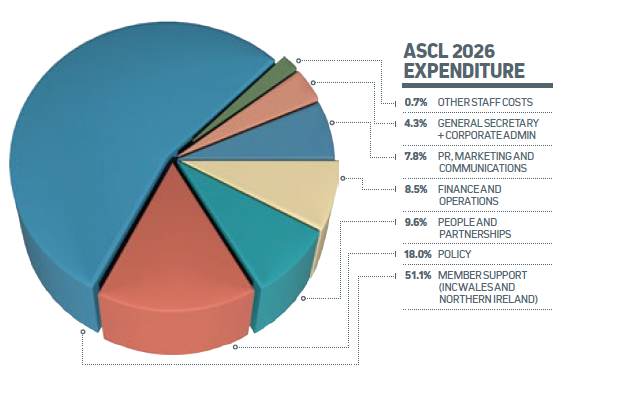
Besides advocating for ASCL members on policy, we pride ourselves on providing high-quality member support services in times of need. The biggest share of our staffing costs is spent on these services in England, Wales and Northern Ireland.
Our member support services continue to receive very high satisfaction ratings, and we have responded to growth in demand and the complexity of cases. This year we have seen an increase in casework on issues directly linked to the challenges faced by our membership.
Our support services include our
hotline team who are just a phone call away for any member who needs support or advice on any employment or professional matter; our network of regional and field officers; our team of in-house lawyers who support members in times of trouble; and our industrial relations team who have been central to reflecting the voices of members in an ever-turbulent environment.
Our budget
The association's total budgeted income for 2026 is approximately £9 million. The majority of this income comes from membership subscriptions, supported by income from investments, partnerships, events, and other activities.
Membership subscriptions remain ASCL's largest source of income, providing the financial foundation that enables the association to deliver member services, professional support, policy work, representation, and development opportunities.
ASCL has approved a balanced approach to investment and financial sustainability, including the planned use of £100,000 of reserves to support revenue activities, alongside strategic investment in organisational infrastructure.
We continue to maintain a substantial investment portfolio, valued at approximately £7.4 million, providing long-term financial security and helping to support the association's strategic objectives.
The majority of our spending is on staffing, which this year totals £6.4 million. Here’s a breakdown:
 ASCL Cymru
Wales has experienced significant political change this year with the formation of the first non-Labour government since devolution more than 20 years ago.
From the outset, we were clear about what was needed and we set out four key priorities for education.
First, we called for decisive action to tackle teacher and leadership shortages. Second, we called for an end to the education funding crisis. Third, we urged the government to rescue the additional learning needs (ALN) system. Finally, we called for action to ensure that all children are ready and able to learn. This means tackling the barriers created by poverty and delivering genuine equity of opportunity for learners in every community across Wales.
These were not simply election asks. They were rooted in the lived experiences of school leaders and the realities facing Welsh education every day. They reflect the genuine needs of our system and the challenges that schools continue to confront.
And these priorities will not disappear now that the election is over. If anything, our message will become louder, clearer and more compelling.
ASCL Northern Ireland
ASCL Northern Ireland continues to actively engage with policymakers, representatives from arm’s-length bodies, political parties, and other stakeholders to represent our members.
As the Department of Education progresses with the
TransformED strategy, we continue to share our views to ensure that outcomes are in the best interests of the membership and the wider sector, for example on assessment and teacher professional learning.
We have also shared our position on the action plan produced by the education minister in response to the independent review of teacher workload and on the enhanced support model, which sets out proposed reforms to special educational needs provision.
Most significantly, ASCL Northern Ireland continues to push for a budget settlement that meets the needs of the sector and channels resources to where they matter most: the classroom.
ASCL Annual Conference
ASCL organises a range of conferences and courses each year. Our biggest event is our Annual Conference, which takes place each March. This year, ASCL President Jo Rowley spoke of the importance of policymakers, parents, and educators working together to meet challenges and find solutions. And ASCL General Secretary Pepe Di’Iasio talked about how kindness lies at the heart of education and how it must extend to how we treat ourselves.
Next year, our conference returns to Birmingham where the theme will be ‘shaping a fairer future’. You can book
here
In conclusion
ASCL is proud to represent a growing membership of more than 25,000 school and college leaders from across the UK. We aim to provide high-quality representation and support to our members in all contexts and locations, and everything we do is shaped by our motto:
We speak on behalf of members, and act on behalf of children and young people.